Receipts
Screens straight out of the app, uncropped. I'll walk you through any account on a call.
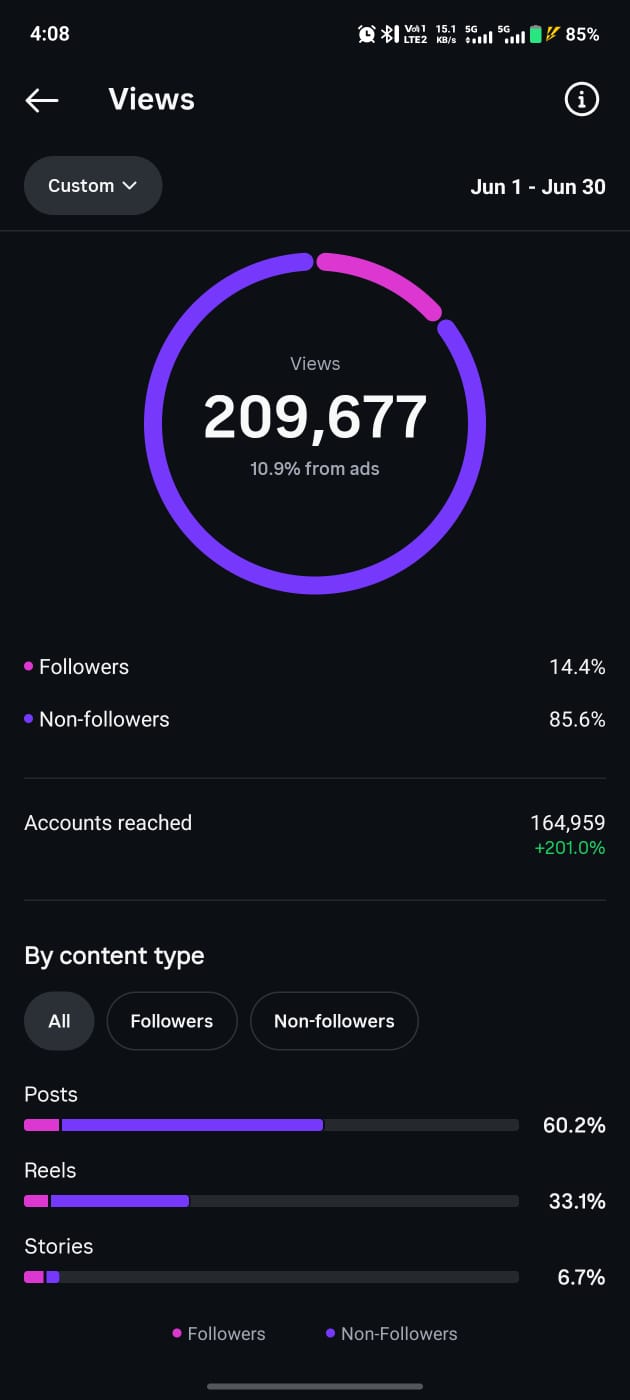
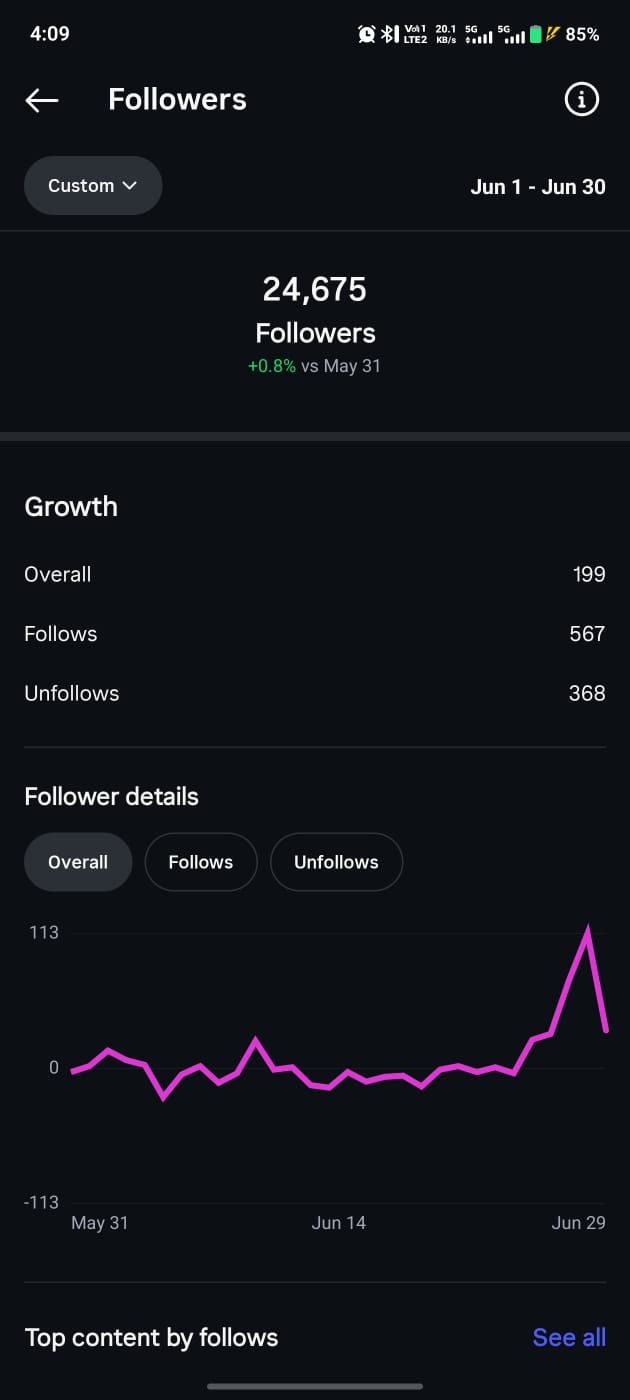
Full monthly reports for each account are available on request, with the client's permission.
Work
Five accounts across education, clothing retail, trading and recruitment. Every figure comes straight off a Meta Ads Manager export or an Instagram Insights screen, in a named month — no rounding up. If your business looks like one of these, the numbers below are roughly what we should be talking about.
Retail, trading and recruitment accounts run during my time at Arab Media, Kochi. The education and freelance work is my own.
On a ₹1,000 daily budget. Volume is easy to buy; the number that mattered here was what happened after the enquiry landed.
A Kollam fabric and clothing retailer running 90 campaigns through the Onam window, alongside two Instagram pages that between them added 3,190 followers in a month.
Splitting the account by geography instead of by course took an enquiry from ₹309 to ₹44.52 in a year — and June showed how quickly that can slip back if nobody is watching.
Forty-nine campaigns across stock market, forex and dropshipping courses — and an eightfold spread in cost per enquiry inside a single fortnight.
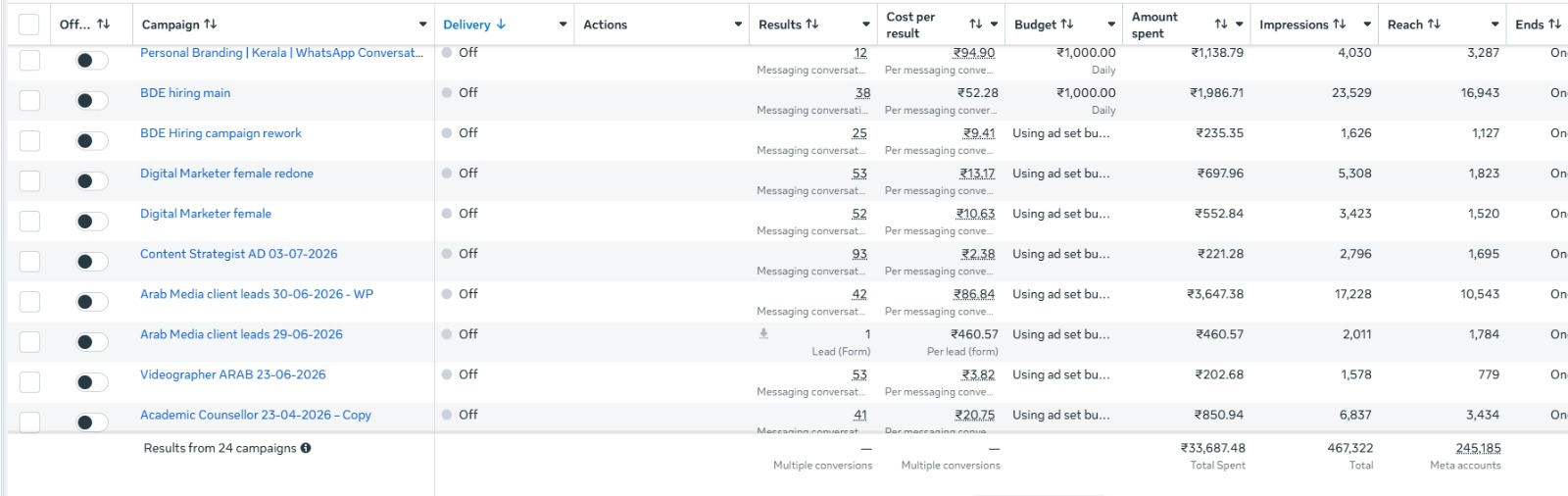
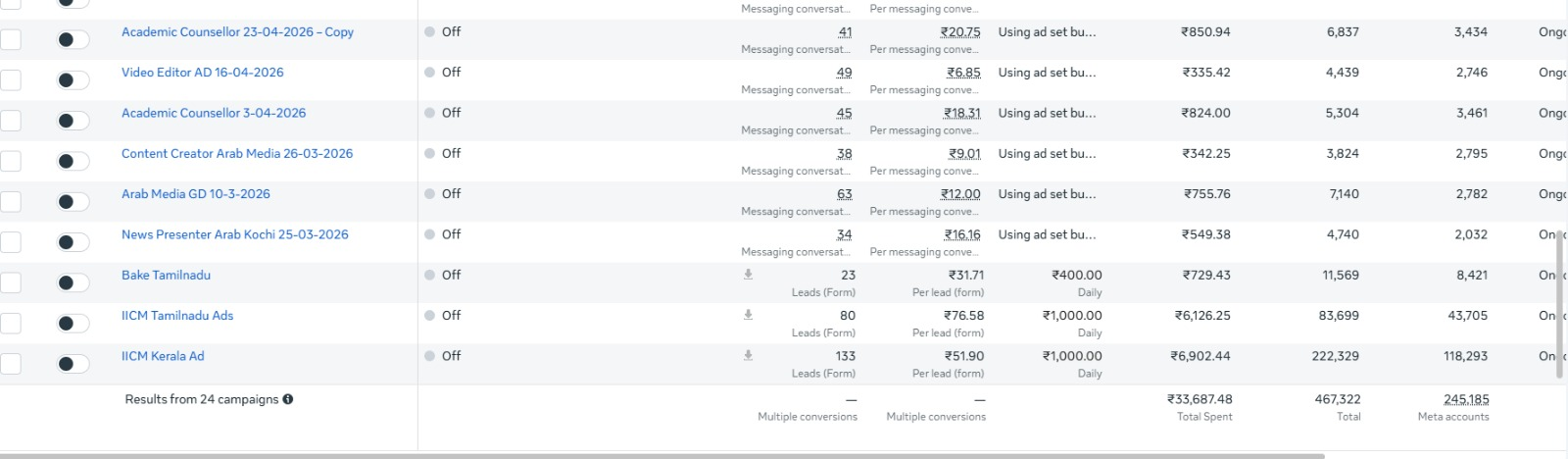
Twenty-four hiring and client lead campaigns in one account. Eleven of the fourteen messaging campaigns converted under ₹21, and the cheapest form leads came in at ₹31.71.
Case study 01 · Lead generation
A ₹1,000 daily budget and a month that did not need a bigger one. This is the result I open with, because it is the one that tells you what to ask me for.
Two hundred enquiries inside twenty days on ₹1,000 a day — under ₹100 a lead. Then seven in ten of those enquiries turned into a customer, which is roughly 140 people from a month's budget of about ₹20,000. Almost every account I have seen since would count the 200 and stop there.
A conversion rate that high is not something the ad platform gives you. It comes from qualifying hard at the form so the wrong people never enter, from matching what the ad promises to what the follow-up actually says, and from a client whose team called people back the same day. Take any one of those away and the same 200 leads convert at a fraction of the rate.
I bring this up on first calls because it sets the terms of the conversation. If you want the cheapest possible leads I can get you those, and you probably will not like what they do to your sales team's week. What I would rather agree on before we start is what a converted customer is worth to you, and work backwards from there.
Case study 02 · Retail clothing, Kollam
A fabric and clothing retailer with two Instagram pages and a large Meta budget going into Onam — the busiest retail window of the Kerala year. I ran the paid account and the organic pages together, and reported on both monthly.
July's export looked healthy on the surface: ₹58,125 spent, 1.11 crore people reached, ₹5.22 per thousand. But almost a quarter of that reach — 24.6% — was landing outside India, with 21.6% in the United States alone. Applied to 10.5 million views, that is roughly 2.6 million impressions delivered to people who cannot walk into a shop in Kollam.
13,495 people visited the Instagram profile that month. 123 of them tapped the bio link. Under one per cent. The account was buying attention brilliantly and asking for the sale badly.
August delivered 23.4 million reached at ₹4.62 per thousand — a full Onam month bought at a ₹3.76 blended CPM. The recruitment campaigns produced 1,512 conversations at ₹7.87 and 150 form leads at ₹5.76, the most predictable results in the account. One partner, Southfliq, reached 1.42 million people for ₹2,746 — ₹1.93 per thousand, less than half the account average, and three times better than the most expensive collaboration in the same month.
Partner choice swung the cost of reach threefold within one account, in one month. Nobody was tracking that before, because everyone was looking at follower counts. And I flagged the remaining leak in my own report: six campaigns ran above 1.8 frequency, paying twice to reach the same people. That is September's job.
Case study 02, continued · The organic side
The same client's Instagram pages. An ad pointing at a dead profile wastes the click, so the organic side was run in step with the paid.
The main page went from 10.55 million views in July to 13.04 million in August, reaching 2.57 million people — with 98.1% of those views coming from accounts that didn't follow the page. Four reels recruited 541 followers between them, the top one bringing in 255 on its own. Every one of them was street-level footage of real people rather than product photography.
The smaller of the two pages, at 17,084 followers, was growing 60% faster than the main one and converting profile visits into link taps at 2.8% against under 1%. It was also the page getting the least push. That is the page the catalogue and the WhatsApp ordering link now sit on.
The same ₹19 kids-dress reel earned 1.3 million views on one page and 6,800 on the other. Cross-posting doesn't carry performance — each account has to earn its reach separately. Worth knowing before you build a content plan on the assumption that it does.
Case study 03 · Education
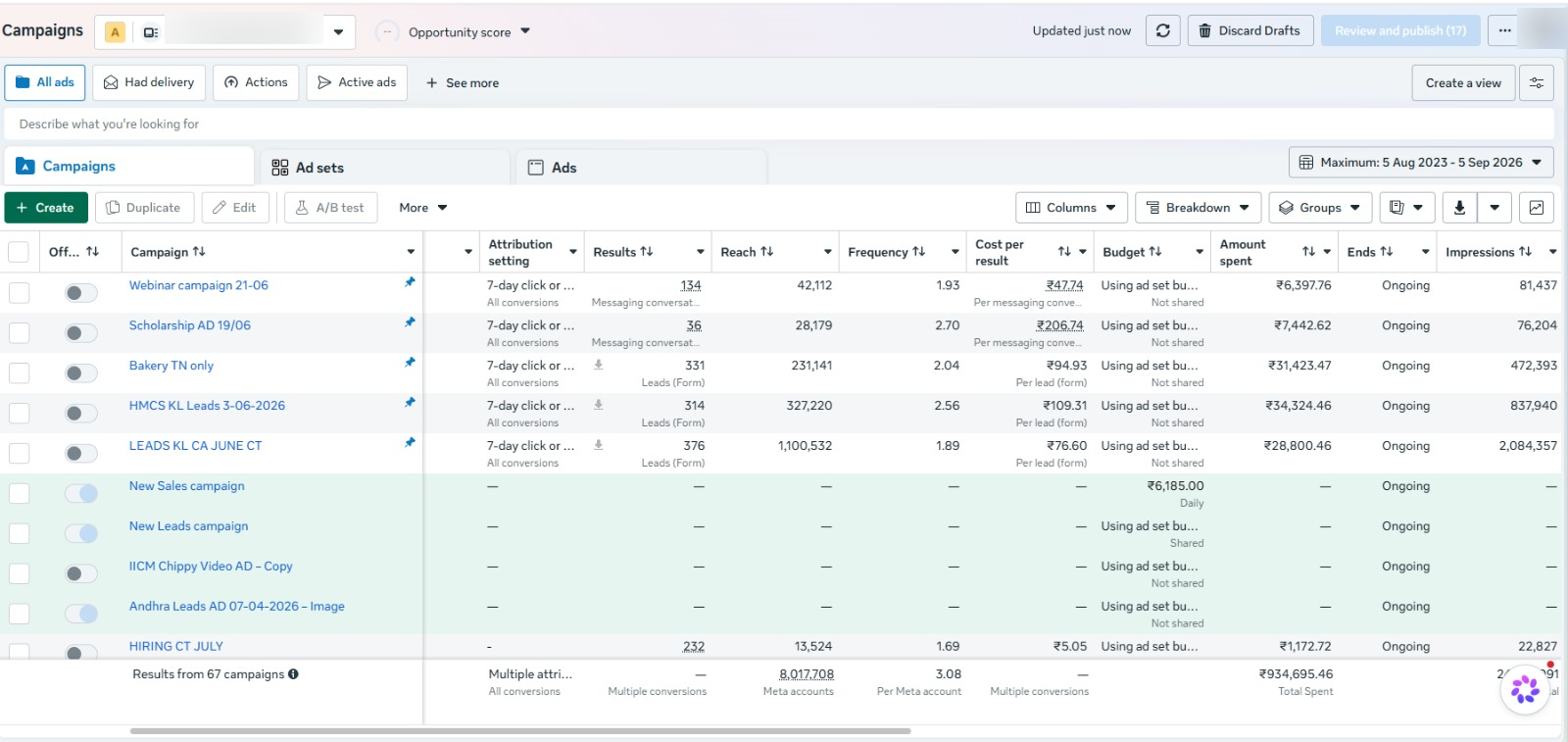
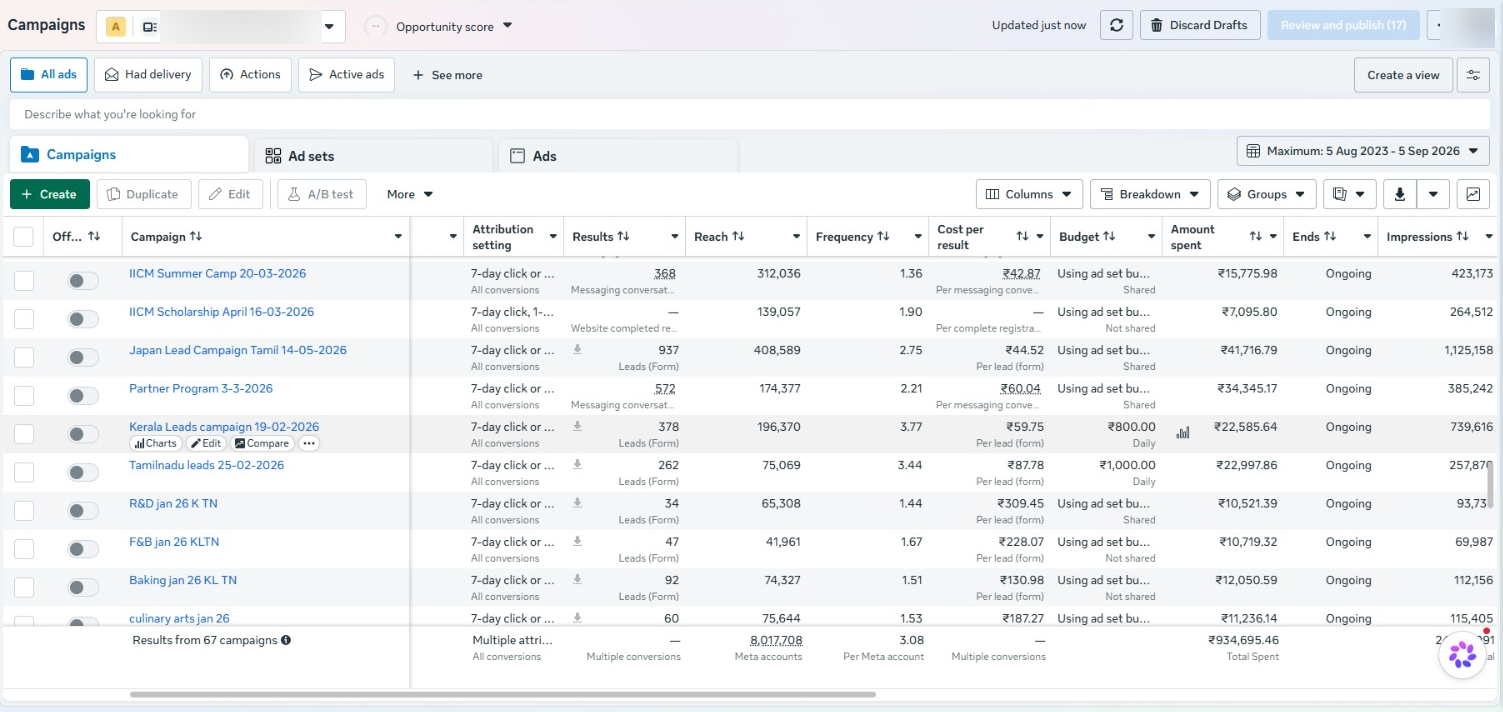
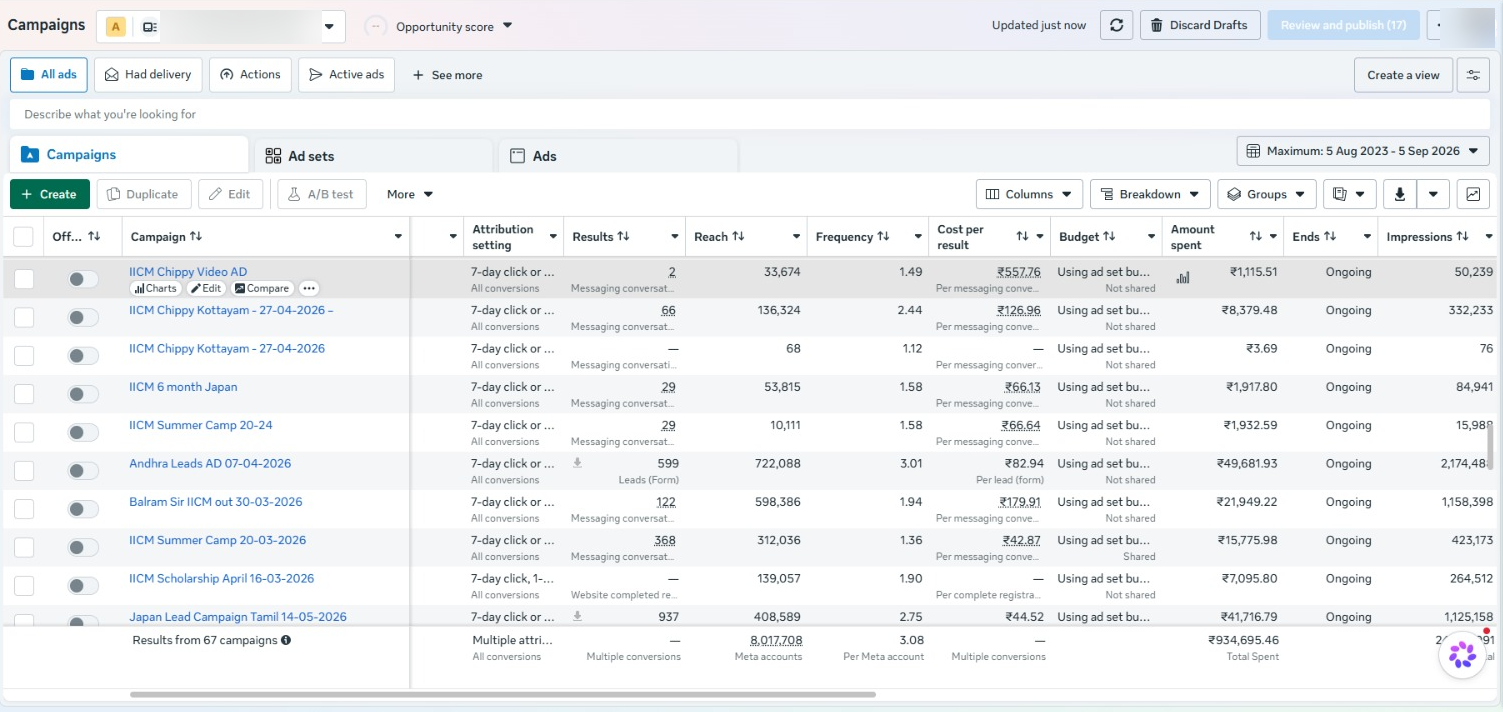
An education client running Meta lead generation at scale: 67 campaigns, ₹9.35 lakh, eight million people reached. Over one year the cost of an enquiry fell from ₹309 to ₹44.52 — and the reason was not the creative.
The account was running one campaign per course vertical. Research and development brought leads in at ₹309.45, food and beverage at ₹228.07, culinary arts at ₹187.27 and baking at ₹130.98. Two hundred and thirty-three leads for about ₹44,500, and a spread that told us the courses were competing for the same people rather than finding different ones.
Same offer, restructured around where people were rather than what they wanted to study. Kerala returned 378 leads at ₹59.75; Tamil Nadu returned 262 at ₹87.78. Six hundred and forty leads in a month, at less than half January's worst campaign — and Kerala came in 32% cheaper than Tamil Nadu on identical creative.
937 form leads at ₹44.52 each, from 408,589 people reached — the highest volume and the lowest cost the account has recorded. Eighty-six per cent below January's worst campaign, on roughly the same monthly budget.
The next set of campaigns came in at ₹76.60 and ₹109.31, with frequency climbing to 2.56 and 3.77 — the same audiences being served the same ads repeatedly. Gains in an ad account are rented, not owned. That is what the monthly reporting is for.
Two campaigns ran in the same month on nearly the same budget: ₹40,507 and ₹40,385. The first returned 245 leads at ₹165. The second returned 62, at ₹651. Click-through was actually higher on the expensive one — 1.00% against 0.64% — so the creative was not the problem. The structure was. Guessing wrong cost about ₹30,000 in a month.
Alongside enrolment leads: 1,590 messaging conversations at ₹63.16 blended, including a recruitment campaign at ₹5.05 with a 2.43% click-through — cheaper than any enrolment lead by a factor of fifteen. A summer camp campaign converted at ₹42.87 across 368 conversations, while a scholarship campaign in the same period cost ₹206.74.
Geography beat course vertical as a way to split this account, and it wasn't a one-off — a separate account I run showed the same thing in the same months, with Kerala leads at ₹51.90 against Tamil Nadu at ₹76.58 on an identical daily budget. Two accounts, same pattern. That is the sort of thing you only find by testing structures against each other rather than swapping creative and hoping.
Case study 04 · Trading education
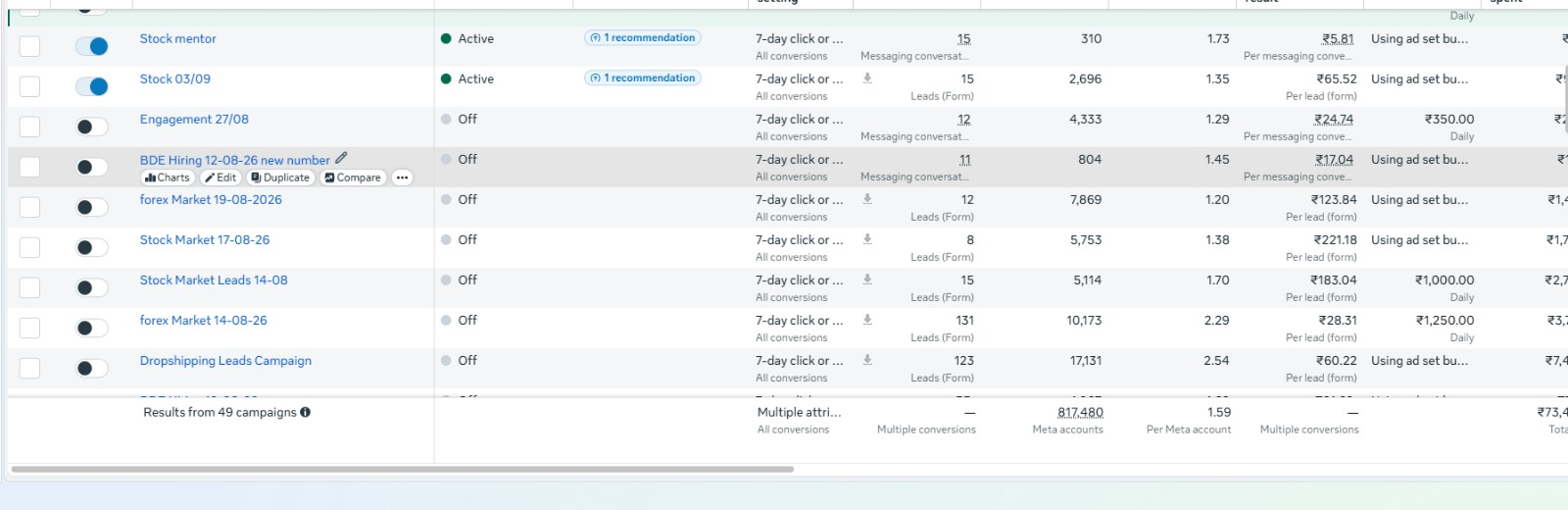
Forty-nine campaigns selling stock market, forex and dropshipping courses. The same account, the same fortnight, the same kind of offer — and an eightfold spread in what an enquiry cost. This is the account that taught me to move budget weekly rather than monthly.
A forex campaign launched on 14 August returned 131 form leads at ₹28.31 each — the cheapest enquiry in any account I run. A dropshipping campaign brought 123 in at ₹60.22. On the messaging side, a stock mentor campaign converted at ₹5.81 and a recruitment ad at ₹17.04.
By the start of the next month the numbers had turned. ₹16,747 spent in ten days for 97 messaging conversations at ₹135.74, against ₹32.17 in July — spending 2.4× faster while converting 4.2× worse. One ad had taken 176,683 impressions, 54% of the entire account, at a CPM of ₹13.56, and returned five conversations at ₹479 each. Impressions that cheap next to conversion that poor points at low-value placements or an audience nowhere near the buying profile.
An account with this much variance cannot be reviewed monthly. Somewhere in that fortnight was a campaign returning leads at ₹28.31 and another at ₹221.18, and every day nobody moved the budget was a day of paying the second price. The export also carried no revenue values, so I couldn't calculate return on ad spend and said so in the report rather than substituting a number that looked better.
Case study 05 · Recruitment
If you are hiring, this is the cheapest thing Meta does. Twenty-four campaigns filling roles — business development, digital marketing, content, video, counselling — alongside client lead campaigns in the same account.
The original business development advert spent ₹1,986.71 and returned 38 conversations at ₹52.28 each. I rebuilt it — new angle, new copy, tighter targeting — and the second version returned 25 conversations at ₹9.41. Eighty-two per cent cheaper per conversation, on roughly a tenth of the budget.
I redid the digital marketer advert as well. The original was converting at ₹10.63; the new version came back at ₹13.17 — about a quarter worse. I kept the original. Two rebuilds, one clear win and one clear loss, is roughly the hit rate you should expect, and it is the reason for testing rather than replacing.
Alongside the hiring work, four campaigns ran for form leads and returned 237 of them at ₹59.99 blended. The strongest was an education client in Kerala: 133 leads for ₹6,902, at ₹51.90 each, from 118,293 people reached. The same offer running in Tamil Nadu on an identical ₹1,000 daily budget returned 80 leads at ₹76.58 — 48% more expensive per lead for a fraction of the reach. A smaller regional campaign beat both at ₹31.71.
Budget size predicted almost nothing here. The two cheapest results in the account came from campaigns spending ₹221 and ₹203, while ₹3,647 on a client lead campaign returned conversations at ₹86.84, and a separate form-lead campaign spent ₹460.57 to produce exactly one lead before it was switched off. Two patterns held across all 24 campaigns: specific beat generic — an advert written for one named role outperformed broad creative every time — and geography moved the cost per lead by nearly half on an offer that was otherwise identical.
Screens straight out of the app, uncropped. I'll walk you through any account on a call.
Full monthly reports for each account are available on request, with the client's permission.
I'll walk you through any of these on a call — campaign structure, what the exports showed, and what I changed because of it. Easier than reading about it.